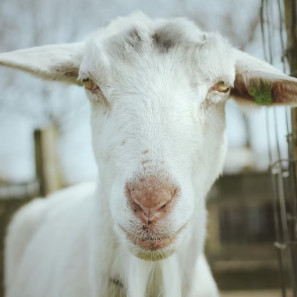
What Did Jesus Say About Goats?
Misunderstood And Oft Quoted
At the end of the parable of the sheep and goats, Jesus says:
And it hits us like a jolt: how can a God who is love even consider burning sinners forever?
No sane person would hold someone’s finger in a flame for five minutes while they screamed. Not an hour. Not a day. Not a week, a year, a decade, a millennium—and still listen to the screams. So something in the traditional reading has gone wrong.
And if we truly intend to take Jesus seriously, we cannot shuffle our feet, avert our eyes, or mutter half-hearted excuses.
The problem is not with the word punishment, since classical Greek differentiates between τιμωρία (timoria) being retaliatory punishment as opposed to κόλασις (kolasis) being corrective punishment intended for the good of the recipient. And 'kolasis' is the word used in the parable.
In fact Clement of Alexandria, an early church leader, makes this very point himself in "The Stromata", citing Aristotle's precise definitions in "Rhetoric". Other contemporaneous sources such as Aulus Gellius make the same point. There has been considerable discussion about how to interpret 'kolasis' in this verse for the last 2000 years!
And while the word eternal—and indeed the whole concept of eternity is less significant, it has seriously confused our theology.
So let us put it under the microscope.
Eternity, The Ocean Of Timelessness
That is the popular view, and that God created a droplet of time and space for us to temporarily live in. How many times have I sung that "I'll be there" ... "when the trumpet of the Lord shall sound, and time shall be no more, and the morning breaks, eternal, bright and fair".
Well, to be blunt, it is wrong. Scripture doesn't support that idea at all.
Two specific words are routinely used in the Bible - עוֹלָם ('olam') in the Hebrew Old Testament, and αἰών ('aeon') in the Greek New Testament. These, in many places, have been consistently translated in most major versions, including the ancient Latin ones, into that troublesome word 'eternity'.
There has been much contention and disputing over the precise meaning of these words, but the nearest synonym in English, is certainly not 'eternity' with it's shades of never-ending, but simply the word 'age'.
Those disputes have appealed to the changing understanding of early Hebrew, to the correlation of words via the Septuagint, to the worldviews of Jesus’ contempories, but it remains evident that these words and associated phrases (into the age, from the age, etc) remain enigmatic.
This is why some prefer to translate the phrase 'eis ton aeona' as 'never ending' because it is easy to understand.
But here's the problem.
A large number of Bible references use 'olam' and 'aeon' in phrases which demonstrably prove that they simply cannot always (and possibly never) mean 'never ending'.
To begin with, 'olam' (singular) or 'olamim' (plural) occurs 448 times in the Old Testament. For example, in Genesis, the rainbow was a sign of a covenant 'berith olam'. Clearly the rainbow was not without a beginning.
Again in Genesis, we are told the Nephilim were around in those pre-flood days and had been from 'olam'. Obviously not from eternity, but maybe from ancient times, or some such.
The book of Exodus instructs slaveowners that slaves were bound to their masters 'le olam' - that is, until they died at some future unknown date. In Numbers, the trumpet's sound is referred to as 'olam'. The twelve stones taken out of the Jordan river, were set up as a memorial 'ad olam'. Samuel was taken by his mother Hannah, to live at Shiloh, 'ad olam'. In Proverbs, the instruction is to avoid removing the 'olam' landmarks.
All these things, the slaves, the trumpets, the Jordan stones, Samuel's Shiloh home, and the landmarks are all long gone. None of them eternal. Moreover, there are scores and scores of Old Testament verses where the word 'olam' denotes not eternal but more probably 'ancient' or 'an unknown time'.
It is true that there are many places where the word 'everlasting' could make sense, but then so would a whole range of other words! But in places which cry out for the word 'everlasting', for example ...
... the word 'olam' is not used. Instead it is the phrase אֵין קֵץ (ʾên qēṣ) that is used - because it precisely means 'no end'!
Some have tried to suggest that when 'olam' is used in the plural 'olamim', then eternity is intended. However, the same problem arises.
King Solomon said he had built a house for God to live in 'olamim'. But he must have known it would not last forever! It was, after all, made of wood and stone! Having said that, it did last about 500 years, which was a tremendous tribute to old Solomon, but still it falls rather short of 'eternity'!
King David says in ...
I have considered the days of old, years of 'olamim'.
Obviously his memory, even poetically, can only have stretched back to ancient times. He is certainly not claiming to be able to consider past eternity!
There is a handful of places where the expression 'from olam to olam' is used. Again these cannot be expressed as 'from eternity to eternity' nor 'from everlasting to everlasting'. For example, Jeremiah urges the Jews to change their ways, so that God will cause them to live in the land 'from olam to olam'. Clearly they had not been in the land from eternity past. The expression 'from age to age' is probably the best that can be done.
All that we have said about 'olam', can similarly be said of the Greek equivalent 'aeon'. And we know that because when the Hebrew scriptures were translated into Greek around 150 years before Christ, over 95% of the Hebrew 'olam's were translated as the Greek word 'aeon'.
Nevertheless, 'aeon' has routinely been translated as 'everlasting' or 'eternal'. However, in some contexts, this makes no sense at all, and so it was translated as 'world' instead.
But if we simply stick to the word 'age' throughout, then everything becomes more straightforward, and modern translations tend to be more consistent in this. Thus we learn that Jesus promises to be with his disciples, not until the end of the world, but until the end of the age.
Consider the verse in Luke 16:8 - both the KJV and the NIV render it like this:
Evidently the translators realised that the phrase 'the people of this eternity' would have made no sense!
And there are many verses in the New Testament like this. There is a cluster in Matthew 13 which refers to 'the end of the aion', translated as 'end of the world'. In 2 Corinthians 4, Satan is referred to as 'the god of this aion'. I guess no translator wanted to cast Satan in the role of 'the god of this eternity'!!
Sometimes the translaters render it as 'for ever and ever'.
It would have been more helpful to stick closer to the original, because that would not lead us to wrongly assume we understand the way the future works! "To him be glory in the church and in Christ Jesus to all generations of the age of ages. Amen"
Some people have considered that the phrase 'aeon of aeons' must be a kind of super-aeon which includes all the other 'aeon's, and therefore this super-aeon must be unending. But there is no contemporaneous use of that Greek expression, and it appears to be just a transliteration (i.e. a word for word translation) of the Hebrew. Phrases such as King of kings, Lord of lords, song of songs, Holy of holies in Hebrew indicate the importance of the king, lord, song or holy place. The idea that this super-aeon is unending is not indicated within the text, but rather that there is one age which is the most important one, for our purposes.
Consider the verse in John 11:26 - the KJV has
and the NIV has
In this case, the translators simply omitted the greek phrase "eis ton aeona" altogether. If they had included it, the NIV would read "whoever lives by believing in me will never die to the age." While we can sympathise with the difficulties of translation, if the original is trying to express something difficult, then perhaps we English speakers should also be given the chance to try to figure it out!
At least footnotes should help.
Something Surprising Emerges!
Once the translation inconsistencies are fixed, lots of verses get more difficult to understand. This is most definitely not a bad thing. For far too long, I have been dogmatically certain of things without any proper study or consideration! And I may not be the only one!
But then the Bible expresses a whole lot of fascinating things about the ages! Throughout the New Testament, there is the sense that we are in 'this age', that there will come a generation that encounters the 'end of the age', that there have been 'ages past' and there are yet more 'ages to come' in which a whole bunch of things will be very different. This is a very different picture from the popular notion of a droplet of time in an ocean of eternity.
God's purpose is set in the context of a number of ages. Paul says at the start of his letter to the Ephesus church ...
... and then later on describes how he, Paul, has been given the task ...
And you may be familiar with this in Hebrews 1:2 then Hebrews 11:3 in the NIV -
But now see it with the word 'ages' kept in, and a closer translation of the word katertisthai.
Now it is clear this is not limited to the creation of the universe, but the purpose of God runs in the widest context of a succession of ages.
And about that purpose, Paul says in the same letter...
The age to come - that is the next one - is contrasted everywhere with this present age. There is something about the life in that most important age, which is described as 'life of that age' (Mark 10:30). Whereas this age can weigh us down with worry and frustration (Mark 4:19), that age is characterised by glory (Matt 13:43) and power (Heb 6:5).
Jesus said this in ...
And this is (aeonian) life, that they know you the only true God, and Jesus Christ whom you have sent.
This must surely then be the principle characteristic of life in that age - the knowing of God.
But even that age to come is not the focus of Jesus teaching. Instead he teaches and demonstrates how to live in this present age. This is because we understand from a number of parables, that supremely this is an age of opportunity. We encourage children to grasp the opportunity of schooling, and young people the opportunities of further education, because we appreciate (whether actually or vicariously) the later rewards that this brings.
So Jesus encourages us. The seed of this age becomes the harvest of that age. The talent of this age becomes the city of that age. To the person who makes the most of opportunities, more is given. For the person who doesn't, the window of opportunity closes, or at least shrinks! It is possible, though not conclusive, that we can gain in this age what we can never gain in the next.
We can be absolutely certain that since the Bible says there have been past aeons (plural), and aeons (plural) to come, then the word 'aeon' cannot possibly mean eternity, if by that we mean unending time.
And that somewhat technical discussion creates a whole new possibility for the future of the goats in Jesus' parable!
A future which is compatible with the character of Jesus Christ.
And with our Father God who is love through and through.

.
Real contents are missing.
Necessary padding text to presize the scrollable div
Error.
Real contents are missing.
Necessary padding text to presize the scrollable div
Error.
Real contents are missing.
Necessary padding text to presize the scrollable div
Error.
Real contents are missing.
Necessary padding text to presize the scrollable div
Error.
Real contents are missing.
Necessary padding text to presize the scrollable div
Error.
Real contents are missing.
Necessary padding text to presize the scrollable div
Error.
Real contents are missing.
Necessary padding text to presize the scrollable div
Error.
Real contents are missing.
Necessary padding text to presize the scrollable div
Error.
Real contents are missing.
Necessary padding text to presize the scrollable div
Error.
Real contents are missing.
Necessary padding text to presize the scrollable div
Error.
Real contents are missing.
Necessary padding text to presize the scrollable div
Error.
Real contents are missing.
Necessary padding text to presize the scrollable div
Error.
Real contents are missing.
Necessary padding text to presize the scrollable div
Error.
Real contents are missing.
Necessary padding text to presize the scrollable div
Error.
Real contents are missing.
Necessary padding text to presize the scrollable div
Error.
Real contents are missing.
Necessary padding text to presize the scrollable div
Error.
Real contents are missing.
Necessary padding text to presize the scrollable div
Error.
Real contents are missing.
Necessary padding text to presize the scrollable div
Error.
Real contents are missing.
Necessary padding text to presize the scrollable div