Taking Jesus Seriously

Contact
Share ...
sausages graphic sausages graphic

Accurately Handle The Word Of Truth


tjs background graphic
Sidebox jvp.jpg graphic for section 1

What Is It With All That Violence?

If you find it all too much, you are not alone! When reading scripture, many people struggle with the violence depicted in the Old Testament. Not to say the book of Revelation. Some avoid those parts altogether! It all seems so out of kilter with the gracious forgiving of Jesus.

But he was raised on the scriptures. And quoted them frequently. So perhaps the best way forward is to examine how Jesus dealt with the apparently heartless and careless references to violence within scripture.

Other articles in this series have considered how Joshua led what could justifiably be called a genocide when conquering the promised land. But the violence of the Old Testament is not confined to Joshua's time. Jeremiah, Lamentations, Ezekiel and Hosea all celebrate violence in God's name. Genocide, infanticide, cannibalism and rape all seem to have God's approval in the relevant Old Testament passages. Over a hundred passages in the Old Testament have God commanding humans to kill. Over a thousand passages in the Old Testament describe violence done in God's name.

And this supposedly God-sanctioned violence has been continued down through history. So we discover Christian crusades slaughtering Muslims 'in Jesus name', Oliver Cromwell slaughtering Roman Catholics while calling them 'Canaanites', and British settlers in North America murdering indigenous indian tribespeople calling them 'Canaanites'.

As recently as 1994 during the Rwandan Genocide, the Tutsi's referred to the Hutu's as 'Canaanites'.

So how can we accurately handle the word of truth? How can the Bible, the scriptures, be the word of God to us when it contains so much conflicting morality.

When discussing the morality of violence, we should begin be clearly disentangling the following three categories:

Retribution/payback/revenge/eye-for-eye/vendetta

Correction/warning/disincentive

Containment/restriction/prevention/greatest-good-for-greatest-number

It is clear that the first category can never be an expression of love, whereas the other two most certainly are.

And Jesus' words in Matthew 5 tell us that God is not governed by a principle of retributive symmetry in which harm is actively returned in proportion to harm done.
Moral order, judgment, and consequence are real, but they do not operate as a divine payback mechanism.

But for the vast majority of people, those categories are very easily confused. And complicating the picture is that within one violent action, all three motivations may be present. And the actions and actors of scripture and the translators of scripture are not immune to that confusion.

God may command violence as a merciful containment, or allow violence as an inevitable consequence, but the human actors involved are most likely to embrace that violence as revenge. And scripture does not usually delve into motivation.

However, some scripture passages do appear to describe God commanding retribution. Of course we know that scripture is God breathed.

However, let us not forget that Adam also was God-breathed - and Adam lost his way and humanity no longer faithfully conforms to the image of God. And neither does scripture. Both Jesus and Paul made that clear. And yet God has caused it to be written, and preserved it so that we not only learn about him, but that we meet him in relationship.

We may expect that scripture, being inspired by God, would have a consistency throughout its revelation. We might anticipate a coherent message if God is wanting to communicate with humanity. As a result, many of our theologians look for a systematic theology to settle on a clear definition of truth concerning all matters of faith and practice.

And those of us who bring that expectation to our bible studies immediately run into a contradictory confusion.

It is helpful to consider how scripture was viewed in Jesus' day. The rabbis held the scriptures to be authoritative and binding. But because they read it as a record of many voices, disputing, debating, arguing over what God wants, over what God is like, it was considered to have multiple legitimate interpretations. The richness of divine truth was considered to be too deep to be expressed in a single presentation. Lively debate was a valued study method.

Clearly the spirit of the law can only be documented by the letter of the law. And yet 'slavish obedience to the letter of the law' often caused the priesthood to forget the importance of the spirit of it!

Thus the prophets role was that 'challenging search for the spirit of the law'. The altogether familiar clash between the establishment and the radical (i.e. root) if you like. That, by the way, is not to say the prophets always got it right!

And Jesus stood within that debating tradition, usually in the prophet role, as can be seen from his lively discussions with the priests and Pharisees. Significantly, Jesus drives to the root issues much more ruthlessly, and often centres the interpretation on his own person as the Christ.

This is evident when he says:

I desire mercy not sacrifice.

Background graphic for section 2:sacrifice_lamb.jpg

Jesus Reveals The Law's Heart

In the bronze age, many cultures were into child sacrifice to suck up to angry gods. We can see that as God brings Abraham out of that culture into something new, he rejects child sacrifice. Abraham put down the knife. Isaac does not die on the altar. The Old Testament law demanded sacrifices, not of humans, but of animals. And the animals were to be slaughtered in a compassionate way, and often the meat used for food afterwards. God is recorded as spelling out in minute detail in the law, all the procedures to do with sacrifices. And God is establishing a new meaning for sacrifice, which will be fulfilled by Jesus Christ.

Yet later in scripture, the prophet Isaiah is asking God what is happening because the nation is suffering. And God instructs him to tell the people...

"Stop bringing meaningless offerings! Your incense is detestable to me! I cannot bear your worthless assemblies, your feasts, your appointed festivals. I hate them with all my being!"

There is the clash between slavish obedience and faithful humble challenge. The clash between the letter and the spirit.

As you know, the Deuteronomy law in chapter 28 can be summed up as 14 verses of "if you obey you will be blessed and have a happy life" followed by 54 verses of "if you disobey you'll be cursed and be utterly miserable." That's the way, says the law, that life is going to work!

But then we find in the Psalms, King David or Asaph or whoever complaining to God that the wicked are living it up, and we, who are trying to follow You, are getting slaughtered. What are You doing, God? Have you forsaken us?

There it is again! Slavish acceptance of the text, versus faithful humble questioning before God.

When Job gets into a whole load of trouble, his so-called friends come along and lay down the law. "You're suffering Job, so you must have sinned. Actually you're really suffering, so you must have done something really bad. Come on, Job - repent and maybe you'll be forgiven". Job's friends have the 'unquestioning acceptance' attitude to the law.

Job on the other hand is quite happy to challenge God - "Come on God, what are You doing? Why is all this going on? You know I've been faithful?"

And at the end of the book, God rebukes the friends saying, "You haven't spoken the truth about me."

There's the clash between slavish acceptance of the written letter of the law, and faithful humble questioning before God.

So in the Old Testament, we constantly see this clash between the established voice of authority, and the questioning voices from the sidelines.

It is to the great credit of the Old Testament, that the voice of questioning, from the minority sidelines makes it into the record. Usually the powers that be control the narrative so that only the authoritative establishment voice is heard.

So when Jesus comes, it is no surprise that he is not slavishly following the law, but he is questioning it, challenging it, refocussing it, centring it on the spirit, the intent. But because he does it with confidence and authority, it is to the fury of the religious leaders.

They stand in little circle watching, muttering ...

"Who does he think he is? Standing there on the mountain feeding this huge crowd with all this nonsense!

"Love your enemies?? No!! The scriptures tell us eye for eye! Tooth for tooth! God treads down his enemies by his mighty power. They should be trodden down.

"Don't take oaths? Just say Yes and No? Anything more comes from sin? What!!! Oaths indicate sin?? All the patriarchs took oaths. The scriptures say that even God took oaths. What nonsense!

"This man cannot represent God. He abuses the sabbath. He claims God is always working .. on the Sabbath. He refuses the law of execution of criminals. Now what is he saying?? What is he saying now?"

Jesus' voice rings out loud and clear.

"Do not think that I have come to abolish the law or the prophets. I have not come to abolish them, but to fulfill them."

Jesus evidently did not read scripture the same way they were taught to read scripture.

So how do you read scripture?

Background graphic for section 3:open_bible.jpg

Like Jesus?

Because if you don't, you will have trouble following Him.

Does retribution appeal to you? Do you sometimes think, "Well she got her just desserts". Have you said, "Let's see how he likes a dose of his own medicine". Do you believe justice requires that the punishment fits the crime? You know what that is? Eye for eye. Tooth for tooth. Not Jesus' way. Not God's way.

Prison for a child abuser might be required for public safety. It may be justifiable as a disincentive to offend in future. Or debatably even as a message to society. But whatever you feel about such offenders, deliberately inflicting suffering in prison as retribution is not God's way.

Jesus fulfills this law of "Eye for eye, tooth for tooth" by saying that the retribution can only be properly stopped by not responding with payback at all. And to show it can be done, he goes through the horror of Good Friday, without reacting aggressively. He then reminds his followers that he can live in them, and enable them to behave the same way. Moreover he teaches about an entire Kingdom based on such principles which will ultimately overcome the present evil age.

Jesus lived an utterly different life to those around.

He insisted that love should interpret and fulfill the Jewish law of Moses recorded in God's word—even if that meant healing on the Sabbath, touching someone deemed unclean, or eating and drinking with those living lives of sin. When a woman was dragged in front of him accused of adultery, he cited the Torah law which required the accusing witness to cast the first stone. Yet in Jesus' presence, they each discovered that once you take the role of judge seriously before God, you cannot occupy it without condemning yourself.

Again and again Jesus appears to contradict the Torah but in each case love transforms its practical fulfillment.

So as a theologian may ask, "What hermaneutics is Jesus using?"

Or as anybody normal would ask, "How did Jesus know what to accept? What to apply? What to emphasize? What focus to change? What to manifest?"

Let's consider an occasion where Jesus is actually addressing this very point in his teaching. This time, Jesus is teaching people who really want to know the answer, not someone who is trying to score points! He is sitting with his disciples around him. First he defines how to determine whether a particular teaching is what God wants.

Matt 7:12 “So whatever you wish that others would do to you, do also to them, for this is the Law and the Prophets."

And what do those who are committed to following Jesus wish for? Not to be abused, or belittled, or rejected, neither to be indulged or pampered to the detriment of their spiritual health, but to be treated with love, and compassion, as the truth is shared.

Then he teaches them how to distinguish someone who is teaching truth from someone who is teaching falsehood. So Jesus goes on to say ...

Matt 7:15-20 “Beware of false prophets, who come to you in sheep's clothing but inwardly are ravenous wolves. You will recognize them by their fruits. Are grapes gathered from thornbushes, or figs from thistles? So, every healthy tree bears good fruit, but the diseased tree bears bad fruit. A healthy tree cannot bear bad fruit, nor can a diseased tree bear good fruit. Every tree that does not bear good fruit is cut down and thrown into the fire. Thus you will recognize them by their fruits.

So this is the way Jesus interprets the law and teaches God's way. This is the way the teaching of a particular prophet is to be assessed.

By its results.

He is focussed on each individual's needs. And he amends how he applies the law depending on the individual. Amid all the confusion and complexity of Old Testament law, he just assesses what will be the result for this person, the fruit of applying that law to the individual. If the result is negative and destructive and unhelpful and if it is not loving and good and character-building, then he says something different.

This is the principle that Jesus consistently uses in all his interactions with people. Because he loves them. Because he wants them to have abundant life. Because he wants them to flourish and grow. Often that requires positive words, encouraging and constructive.

And let us face the fact that sometimes people require robust challenge, and honest exposure which is initially painful, but ultimately the only way forward into flourishing personal growth. No-one ever needs vindictive destructive criticism with no hope of resolution or reconciliation.

So when Jesus overturns tables, scattering coins, cracking the whip and driving animals out of the temple, he is declaring that the space was intended as a place of prayer. Sometimes love feels severe but it is the only way forward.

And when we read scripture, we need to determine whether we are reading the side of the debate that Jesus would say is helpful and edifying, the side that can be expressed perfectly through love, or whether we are in fact reading the negative, destructive or flawed aspect of the debate.

This is accurately handling the word of truth.

Background graphic for section 4:bigwigs_and_jesus.jpg

The Clash With The Religious Authorities

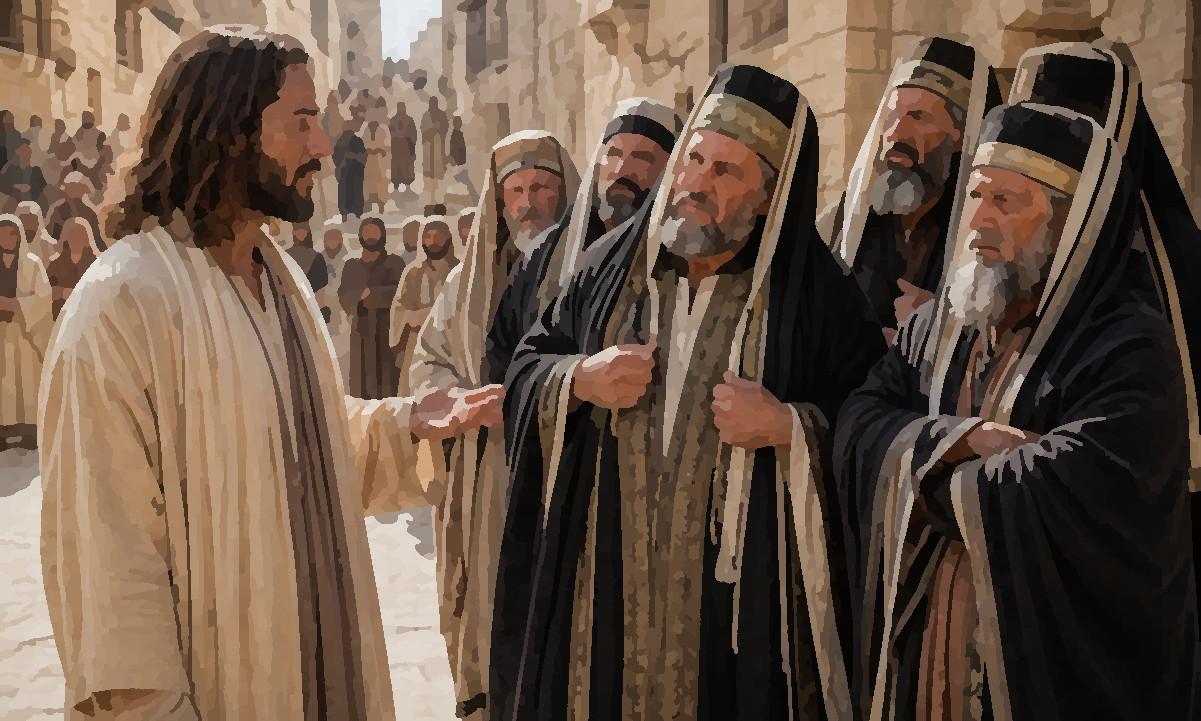
There is an extremely interesting interaction between Jesus and the teachers of the law described in Matthew 15. Picture the scene...

It wasn't uncommon for Jesus to have run-ins with the Pharisees and the teachers of the law. But this time, there were rumours that some of the big-wigs from Jerusalem were down. They'd come 80 miles. This was serious!
And sure enough, there they were stood on the edge of the crowd. Extra big phylactery boxes strapped on their foreheads! And ridiculously long fringes on the edges of their cloaks.

Jesus takes a break from teaching the crowd and they take the opportunity to stroll over trying to look casual.
"We want to ask some questions about your disciples behaviour!"
Jesus waits patiently for them to continue.
"Why do your disciples eat with unwashed hands. You know full well that is against our traditions."

Jesus looks them in the eye, waits a second, then quietly says, "Why do you ignore the commandments of God with your traditions?"
"And," Jesus continues, "how about 'Honour your father and mother!' What happened to that command?" The Jerusalem bigwigs are looking a bit puzzled now. But Jesus is relentless, "How about 'If a child disrespects his parents, he shall be executed.' " They are shuffling their feet now. Because no-one takes that law seriously.

Now you are probably not as well versed with the Hebrew bible as those teachers of the law, so you may not spot the trap that Jesus has set up. So let me give you some background.

Let's say my parents needed some care because they were getting a bit feeble. The law of honouring parents would require me to help them out, either directly or by paying someone else to do it. But the tradition of the Pharisees and teachers of the law said that if I went to my parents and said, "My time is devoted to God and my money is devoted to God, so I am afraid I cannot support you with my time or money.", then I could just leave them to get on with it! That was a Pharisees tradition called 'corban'. And you could avoid a lot of inconvenient responsibilities that way.

But in reality, this truly was dishonouring your parents.

I am not aware that there was any formal tradition about executing children who dishonoured their parents, but it was such an awful idea that people always cited mitigating circumstances, although the law doesn't actually allow any!

So the bigwigs are in a real bind now. Having heard that Jesus was always preaching about loving enemies and compassion for the poor and taking care of your neighbours, they never expected him to start insisting that they execute children for disrespect!

So when Jesus said, "By your traditions, you completely nullify the word of God", they had nowhere to go.

It is almost certain than none of the disciples understood what Jesus was doing either, with this series of question. They knew he had already refused to agree to stoning that woman to death who'd committed adultery, so stoning a rude teenager for being disrespectful didn't fit his usual modus operandi.

But as usual Jesus' message to these legalistic bigwigs was personalised to their need. He knows precisely what they need. They were proud of their law adherance. They need to have their eyes opened so they realise their pride is groundless and sinful. So Jesus used the law to show them they weren't actually following it as faithfully as they thought. In fact, they were allowing their traditions to supersede the law.

The fact is that he deliberately chose the most extreme Deuteronomy law of killing one's own child for the sin of disrespect, he stated that it is God's commandment, and then told them they are failing to keep it!

And all the occasions where we see Jesus get really furious, it is prompted by religious leaders applying the law albeit correctly according to the letter, but in a traditional way that repressed or excluded the poor, the weak, the sick, the uneducated. The way that divided society, created enmity, elevated class consciousness, and destroyed relationships.

Always, Jesus' watchword in his interpretation of scripture is the word LOVE.

That which seeks the growth and flourishing of the individual.

The approach of the Pharisees and teachers of the law, and sadly many church leaders today, is to cherry pick the law according to tradition, while insisting they are law-keepers. Authoritarian, controlling and judgemental - they decide. Self-righteous - they rule. And fear based - they exclude.

Jesus consistent approach to the law was to interpret it by allowing love to have the final say. That ingredient of which relationships are built.

This approach was utterly new. Other rabbis, such as Hillel did accentuate love, but no rabbi ever allowed it to fulfill the law as Jesus did. So the Pharisees struggled, the crowd struggled. Even Jesus' disciples struggled with what Jesus said.

And that is the reason why this next amazing event occurred.

End graphic or Divider graphic

.

Error.
Real contents are missing.
Necessary padding text to presize the scrollable div
Error.
Real contents are missing.
Necessary padding text to presize the scrollable div
Error.
Real contents are missing.
Necessary padding text to presize the scrollable div
Error.
Real contents are missing.
Necessary padding text to presize the scrollable div
Error.
Real contents are missing.
Necessary padding text to presize the scrollable div
Error.
Real contents are missing.
Necessary padding text to presize the scrollable div
Error.
Real contents are missing.
Necessary padding text to presize the scrollable div
Error.
Real contents are missing.
Necessary padding text to presize the scrollable div
Error.
Real contents are missing.
Necessary padding text to presize the scrollable div
Error.
Real contents are missing.
Necessary padding text to presize the scrollable div
Error.
Real contents are missing.
Necessary padding text to presize the scrollable div
Error.
Real contents are missing.
Necessary padding text to presize the scrollable div
Error.
Real contents are missing.
Necessary padding text to presize the scrollable div
Error.
Real contents are missing.
Necessary padding text to presize the scrollable div
Error.
Real contents are missing.
Necessary padding text to presize the scrollable div
Error.
Real contents are missing.
Necessary padding text to presize the scrollable div
Error.
Real contents are missing.
Necessary padding text to presize the scrollable div
Error.
Real contents are missing.
Necessary padding text to presize the scrollable div
Error.
Real contents are missing.
Necessary padding text to presize the scrollable div
Get the whole chapter