Taking Jesus Seriously

Contact
Share ...
sausages graphic sausages graphic

Part 6 - By His Wounds You Are Healed


tjs background graphic
Sidebox bhwyah.jpg graphic for section 1

The Remaining Questions

Previously we noted three questions and only answered one of them! The other two are just as important, so let us consider them now:

And how does the resurrection of Jesus Christ enable me to be transformed? That is what the apostle Peter claimed.

1 Peter 1:3

Praise be to the God and Father of our Lord Jesus Christ! In his great mercy he has given us new birth into a living hope through the resurrection of Jesus Christ from the dead...

How does the suffering of Jesus Christ enable me to be healed? This is the assertion of Isaiah.
Isaiah 53:5

But he was pierced for our transgressions, he was crushed for our iniquities; the punishment that brought us peace was on him, and by his wounds we are healed.

Notice in the Isaiah passage, the Hebrew word often translated “punishment” or “chastisement” is musar (מוּסָר). It does not mean punishment in the retributive sense. It carries the sense of discipline, guidance, instruction, correction—a shaping that teaches, reforms, heals.

Think of a young soldier enduring rigorous training. Pain, effort, challenge—but all with a purpose: to bring out what is latent, to build strength that can endure. That is what Isaiah speaks of: God’s corrective love flowing through suffering, not as vengeance, but as restorative shaping.

Now the words of Hebrews 5:8 (NIV) take us further:

“Son though he was, he learned obedience from what he suffered and, once made perfect, he became the source of eternal salvation for all who obey him.”

But did Jesus himself ever speak about this?
About suffering not simply as something to endure—but as something necessary? Something that would shape him for what lay ahead?

On one occasion, Jesus cut across James and John discussing how they could share Jesus glory when his kingdom came. He asked them this strange question:
“Can you drink the cup I am going to drink?”
Now some time before that Jesus had spelled out that the day would come when having journeyed to Jerusalem, he would suffer death, and then rise again on the third day. Perhaps they had put that out of their minds.
So they said yes, without understanding the question.

But what was this cup?

Background graphic for section 2:lost_sheep_2.jpg

It Was Not Death

It was not even death by crucifixion. The Romans made criminals and rebels drink that cup every day!
No. The cup was filled with human sin, the full force of what twists and tears apart the human heart. Everything, in fact, that would be 'laid on him'.

Jesus knew that this was not incidental to his mission. It was central to it.
And he spoke about it in another way too.

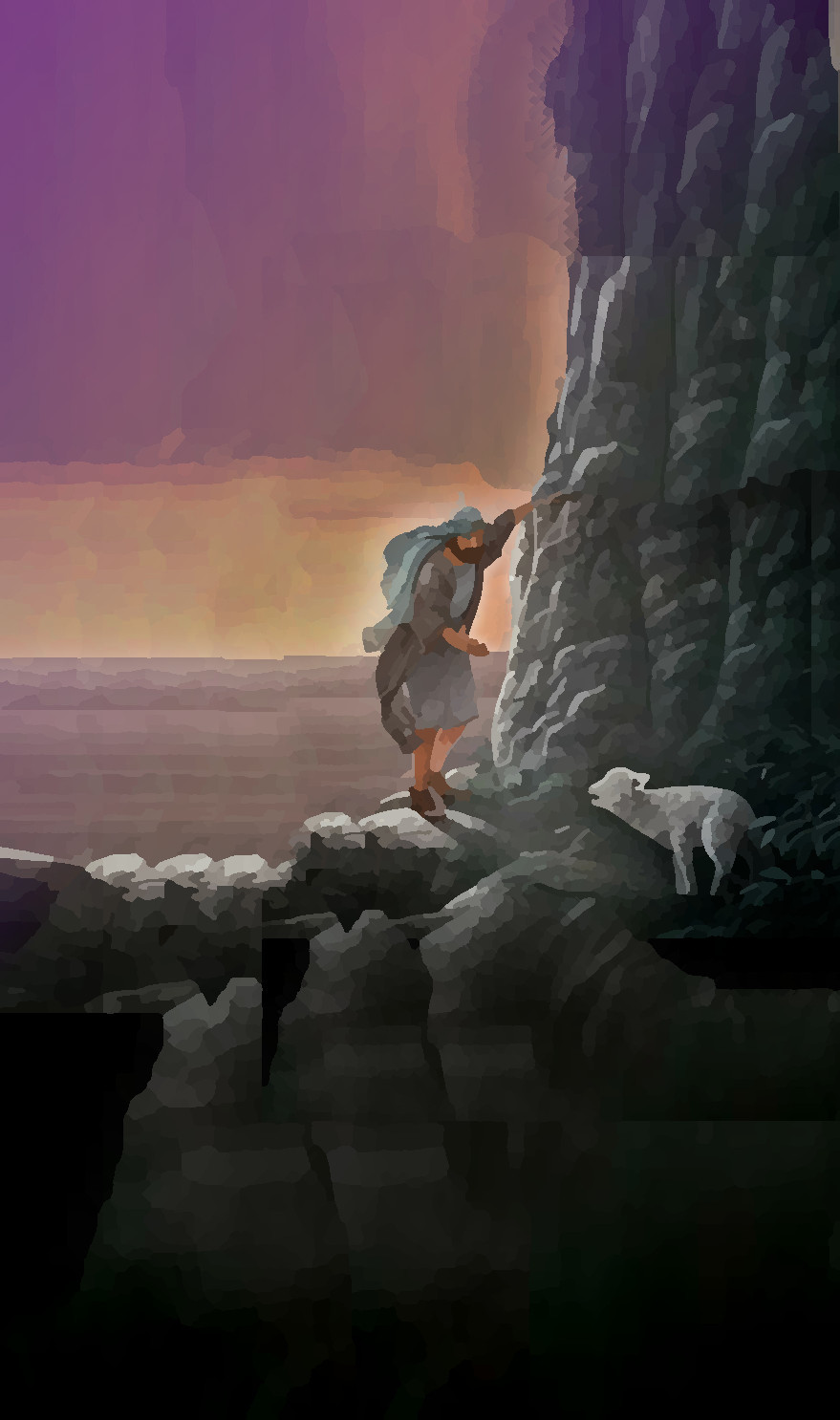
When he described himself as the good shepherd, the one who goes after the lost sheep, he was not describing a casual search. The shepherd walks the same terrain as the sheep. He enters the same danger, he too suffers the wet, the cold, the dark, the brambles, as the sheep. The shepherd experiences the same exposure, the same vulnerability.

The sheep is not rescued from a distance. It is carried home by one who has gone where it went.

Do you see what this means?

Jesus does not heal us from afar. He heals us from within our condition—by entering it, walking it, and overcoming it.
And that brings us back to these remarkable words:

“Son though he was, he learned obedience from what he suffered and, once made perfect, he became the source of eternal salvation…”

Pause for a moment. “Learned obedience?” Surely Jesus was perfect from birth. Morally, yes. But perfect for the task of redeeming the world? Evidently not.

Before the incarnation, God had never experienced what it is like to be fully human: frailty, doubt, social pressure, rejection, betrayal, physical suffering. He had never known the shame of being mocked, beaten, or publicly humiliated. Never felt the betrayal of close friends. And on the cross, the fullness of human abuse and alienation fell upon him.

Literally. Every casual selfish sin of every man, woman or child viscerally experienced. Every planned violent abuse experienced directly within himself.

No human is unaffected by these things. That is why he challenged his disciples, "Can you drink this cup?"

And yet, he did not succumb to rage, bitterness, self-pity, or despair.

This is crucial: through his suffering, Jesus deliberately practiced hope, joy, forgiveness, tenderness, trust, faithfulness, selflessness. Everything, in fact, that was good. Thus he developed within a human life the immunity to the destructive forces of human sin—the same forces that corrupt our hearts and poison our relationships.

And he offers this immunity to us!

Background graphic for section 3:bread_and_wine.jpg

Let’s Picture This

A young woman who recovers from an illness develops antibodies, which she can then pass to her child through breastfeeding. The child is protected simply by absorbing life that flows from the suffering that the mother has endured and overcame.

That is what Peter means when he says:

1 Peter 2:24 – “He himself bore our sins in his body on the cross, so that we might die to sins and live for righteousness; by his wounds you have been healed.”

Healing does not mean simply the removal of guilt. It means transformation, an inoculation of the soul, an infusion of God’s life that teaches, reshapes, and strengthens us to respond as Jesus did.

And the metaphors Jesus himself used anticipate this:

The cup of suffering (Matt 20:22–23) — “Can you drink the cup I am going to drink?” That suffering, borne gladly, that conferred the divine immunity within a human body.

The vine and branches (John 15:1–8) — full freedom and flourishing comes only through retaining the living connection with the source of life.

The good shepherd and the lost sheep (Luke 15:4–7) — he walks the path of the lost, sharing their vulnerability, so that he can bring them home.

These images tell us: the life, the healing, the resilience that flows to us through Christ is not theoretical. It is relational, experiential, and grounded in his real suffering.

And the sacraments echo this truth:

1 Corinthians 11:27-30 — eating the bread and drinking the cup is more than ritual. It is a tangible spiritual practice that opens our inner being so the life of God can flow in, again and again, strengthening us against rage, bitterness, self-doubt, and resentment.

This is why the apostle Paul writes to believers who are not taking part in the memorial supper.

1 Corinthians 11:30 (NIV) “That is why many among you are weak and sick, and a number of you have died.”

It is only by sharing our Lord's very life, that we can act as he did—with patience, forgiveness, tenderness, and love—even in the face of the world’s cruelty.

The atonement, then, is not about retributive punishment, but about forgiveness exercised from within the visceral experience of our sin, about the power of spiritual immunity developed within a human body, and it is about transformation by carrying each of us through death into life.

So amazing!

End graphic or Divider graphic

.

Error.
Real contents are missing.
Necessary padding text to presize the scrollable div
Error.
Real contents are missing.
Necessary padding text to presize the scrollable div
Error.
Real contents are missing.
Necessary padding text to presize the scrollable div
Error.
Real contents are missing.
Necessary padding text to presize the scrollable div
Error.
Real contents are missing.
Necessary padding text to presize the scrollable div
Error.
Real contents are missing.
Necessary padding text to presize the scrollable div
Error.
Real contents are missing.
Necessary padding text to presize the scrollable div
Error.
Real contents are missing.
Necessary padding text to presize the scrollable div
Error.
Real contents are missing.
Necessary padding text to presize the scrollable div
Error.
Real contents are missing.
Necessary padding text to presize the scrollable div
Error.
Real contents are missing.
Necessary padding text to presize the scrollable div
Error.
Real contents are missing.
Necessary padding text to presize the scrollable div
Error.
Real contents are missing.
Necessary padding text to presize the scrollable div
Error.
Real contents are missing.
Necessary padding text to presize the scrollable div
Error.
Real contents are missing.
Necessary padding text to presize the scrollable div
Error.
Real contents are missing.
Necessary padding text to presize the scrollable div
Error.
Real contents are missing.
Necessary padding text to presize the scrollable div
Error.
Real contents are missing.
Necessary padding text to presize the scrollable div
Error.
Real contents are missing.
Necessary padding text to presize the scrollable div
Get the whole chapter